A water park franchise can provide a way to enter the leisure and entertainment industry without developing an entirely new brand from scratch. However, unlike small-format food or retail franchises, a full-scale water park franchise can require substantial investment, significant land and complex infrastructure.
The investment can vary enormously depending on whether you are considering a mini water park, regional family water park or large destination park. Current franchise listings illustrate this variation: Crescent Water Park is listed with an investment requirement of ₹5–10 crore and around 21,780–21,800 sq. ft. of space, while larger destination-scale projects can involve tens or even hundreds of crores.
What Is a Water Park Franchise?

In a franchise model, the franchisee generally receives the right to operate a business using the franchisor’s:
- Brand name
- Business model
- Operating systems
- Marketing identity
- Training
- Design/support
- Technology
- Operational know-how
In return, the franchisee normally makes an initial investment and may pay a franchise fee, royalty, management fee or other charges, depending on the agreement.
The exact arrangement differs from one brand to another.
How Much Does a Water Park Franchise Cost in India?
There is no standard franchise price for water parks in India.
As an example, the current Franchise India listing for Crescent Water Park states:
- Investment: ₹5 crore and above
- Franchise/brand fee: ₹50 lakh
- Royalty/commission: 10%
- Space requirement: approximately 21,780–21,800 sq. ft.
- Listed franchise term: 10 years
- Listed anticipated ROI: 35%
- Listed payback: 3–4 years
These figures are brand-specific claims/listing information, not a guarantee of actual returns.
Other smaller-format entertainment/water concepts can have much lower investment requirements. For example, one listed in-mall water/amusement concept shows a ₹20–30 lakh expected franchise investment, although its broader capital requirement is listed separately as ₹20 lakh–₹2 crore.
Therefore, it is important to distinguish between:
Mini/In-mall Water Concept ≠ Full-Scale Water Park
Main Components of Water Park Franchise Investment
Your total investment can include considerably more than the franchise fee.
- Franchise Fee
This is the upfront amount paid for the right to use the brand and franchise system.
It may cover:
- Brand rights
- Initial training
- Documentation
- Pre-opening support
- Business systems
For example, Crescent Water Park’s current listing shows a ₹50 lakh franchise/brand fee.
- Land
Land can become one of the largest expenses.
A full-scale water park may require several acres, particularly if it includes:
- Large pools
- Multiple slides
- Wave pools
- Lazy rivers
- Parking
- Food courts
- Landscaping
- Future expansion
As an example of the scale involved in established operations, Shanku’s Water Park in Gujarat spans more than 25 acres and has over 25 rides and attractions.
- Construction
Construction costs can include:
- Pools
- Slide towers
- Changing rooms
- Toilets
- Restaurants
- Ticketing areas
- Administrative buildings
- Plant rooms
- Storage
- Internal roads
- Landscaping
- Water Rides
Depending on the franchise concept, this can include:
- Body slides
- Tube slides
- Family slides
- Multi-lane slides
- Kids’ attractions
- Wave pools
- Lazy rivers
Ride selection can significantly influence the capital requirement.
- Water Treatment
A water park needs appropriate:
- Filtration
- Pumps
- Disinfection
- Chemical dosing
- Storage
- Circulation
- Drainage
systems.
- Safety Infrastructure
Investment may be required for:
- Lifeguard stations
- Rescue equipment
- CCTV
- First-aid facilities
- Emergency communication
- Fire-safety systems
- Safety signage
- Pre-Opening Expenses
These can include:
- Staff recruitment
- Training
- Marketing
- Trial operations
- Launch events
- Initial inventory
Does the Franchisor Provide the Land?
Usually, do not assume that land is included in the franchise investment.
In many franchise models, the franchisee is expected to provide or arrange the property.
The franchise agreement should clearly state:
- Who owns the land?
- Who pays for construction?
- Who owns the rides?
- Who pays for maintenance?
- Who pays for utilities?
- Who obtains local approvals?
This distinction can dramatically change the actual capital requirement.
Water Park Franchise Royalty
Royalty is generally an ongoing payment to the franchisor.
It may be structured as:
- Percentage of gross revenue
- Percentage of net sales
- Fixed monthly fee
- Management fee
- Combination of fees
For example, the current Crescent Water Park franchise listing reports a 10% royalty/commission.
But prospective franchisees should carefully determine:
10% of what?
A percentage of gross ticket revenue is very different from a percentage of net profit.
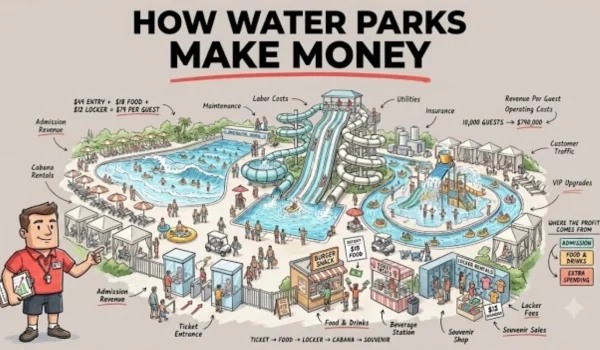
How Does a Water Park Franchise Make Money?
A franchise can generate revenue through several channels.
Entry Tickets
Usually the largest revenue source.
Food & Beverages
Restaurants, cafés, snack counters and beverage outlets.
Lockers
Visitors may pay separately for locker facilities.
Parking
Large parks can charge parking fees.
Events
Potential sources include:
- Corporate events
- School trips
- Birthday parties
- Group bookings
- Private events
Merchandise
Possible products include:
- Swimwear
- Towels
- Caps
- Toys
- Souvenirs
Premium Facilities
Depending on the concept:
- Cabanas
- VIP seating
- Premium areas
- Special experiences
These additional revenue streams can increase the average amount spent per visitor.
Water Park Franchise Profit Potential
There is no guaranteed profit margin for a water park franchise.
Profit depends on:
Visitors × Average Revenue Per Visitor − Operating Costs − Franchise/Management Fees − Financing Costs
For example, suppose a hypothetical park generates:
Annual visitors: 2,00,000
Average total spending per visitor: ₹1,000
Annual revenue:
2,00,000 × ₹1,000 = ₹20 crore
If total operating expenses and other relevant costs are ₹15 crore:
Illustrative operating surplus = ₹5 crore
But this is only an example. Actual profit can be dramatically different.
What About ROI?
ROI is commonly calculated as:
ROI = Annual Profit ÷ Total Investment × 100
Suppose:
Total investment = ₹25 crore
and:
Annual profit = ₹5 crore
Then:
ROI = ₹5 crore ÷ ₹25 crore × 100 = 20%
However, franchise advertisements may quote ROI based on particular assumptions.
For example, Crescent Water Park’s franchise listing currently states an anticipated 35% ROI and a 3–4 year payback period. These figures should be independently verified against actual financial statements, operating data and the franchise agreement before making an investment decision.
Why Location Is Extremely Important
A strong franchise brand cannot completely compensate for a poor location.
Before selecting a site, examine:
- Population within the catchment area
- Distance from major cities
- Road connectivity
- Highway access
- Public transport
- Nearby hotels
- Tourist traffic
- Competition
- Parking availability
- Land cost
- Water availability
The location should ideally be capable of generating enough visitors not only during peak summer but also during other operating periods.
Franchise vs Independent Water Park
Which is better?
| Factor | Franchise | Independent Park |
| Brand | Existing brand | Build your own |
| Business model | Pre-developed | Develop yourself |
| Initial support | Usually available | Self-managed |
| Franchise fee | Applicable | None |
| Royalty | May apply | None |
| Marketing | Brand + local | Fully self-managed |
| Flexibility | Usually lower | Higher |
| Brand risk | Depends on franchisor | Your own brand risk |
| Operational control | Shared/contractual | Greater |
A franchise can reduce some startup uncertainty, but you pay for that support through fees and potentially reduced operational flexibility.
What Should You Check Before Buying a Franchise?
This is perhaps the most important part of the decision.
Do not make a decision based only on:
“Investment ₹5 crore + ROI 35%.”
Ask the franchisor for evidence supporting the numbers.
Check Existing Franchisees
Speak directly with existing franchise operators.
Ask:
- Actual annual visitors?
- Actual revenue?
- Actual operating profit?
- Off-season revenue?
- Maintenance expenses?
- Electricity cost?
- Royalty paid?
- Marketing contribution?
- Actual payback period?
Check the Franchise Agreement
Review:
- Franchise term
- Renewal conditions
- Territory rights
- Royalty
- Brand fee
- Exit conditions
- Transfer rights
- Minimum performance obligations
- Marketing fees
- Non-compete clauses
- Dispute-resolution mechanism
Have a qualified lawyer review the agreement before signing.
A Major Development in India’s Water Park Industry
The industry is also seeing larger strategic investments rather than only traditional franchise models.
In 2026, Imagicaaworld announced an investment of up to ₹100 crore in Mehsana Next Parks, the SPV associated with Shanku’s Water Park in Gujarat. The company also said it would provide operations and management services and potentially earn a 6–10% management fee.
The transaction shows that there are several ways to structure water-park expansion:
Franchise → Management Contract → Joint Venture → Strategic Investment → Company-Owned Park
This is useful for investors because a franchise is not the only expansion model available in the Indian leisure industry.
Is a Water Park Franchise Profitable?
It can be, but profitability depends heavily on the individual location and operating model.
The biggest factors are:
- Initial investment
- Land cost
- Visitor footfall
- Ticket pricing
- Average spending per visitor
- Seasonality
- Operating expenses
- Royalty/management fees
- Debt and interest
- Maintenance costs
- Brand strength
- Local competition
A strong brand in a weak location can still struggle.
Likewise, a good location with poor operational management can produce disappointing returns.
Final Conclusion
A water park franchise in India can require anywhere from tens of lakhs for compact/in-mall concepts to several crores for a full-scale park, with large destination projects requiring substantially more capital.
For example, one current franchise listing shows ₹5 crore+ investment, ₹50 lakh franchise fee and 10% royalty, while larger water-park investments can reach much higher levels.
Before investing, calculate the complete cost:
Franchise Fee + Land + Construction + Rides + Water Systems + Safety + Approvals + Staff + Marketing + Working Capital + Financing Cost
Then compare that with:
Expected Visitors + Ticket Revenue + F&B + Events + Parking + Lockers + Other Revenue
The most important rule is simple:
Never judge a water park franchise only by the advertised ROI or payback period.
Ask for actual operating data, understand the complete fee structure, inspect existing locations, verify the franchisor’s claims and have the franchise agreement professionally reviewed before committing substantial capital.