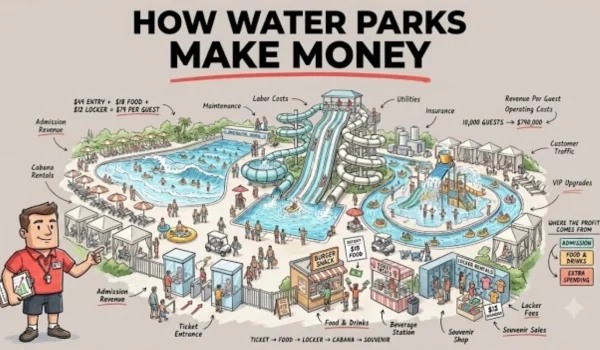
For most water parks, ticket sales are the foundation of revenue—but they are not the only way a park makes money.
A visitor who pays an entry ticket may also buy food, rent a locker, purchase swimwear, pay for parking, book a private cabana, attend a birthday party or spend money on merchandise.
This per-visitor spending can significantly increase the overall revenue of a water park.
Large park operators such as Six Flags track admissions separately from food, merchandise, parking, games and other in-park products, highlighting the importance of generating revenue after the customer has already entered the park.
Here are 10 major revenue sources beyond ticket sales that water-park owners can use.
Food & Beverage Sales
Food and beverages are among the most important additional revenue sources.
A water park can generate revenue through:
- Restaurants
- Food courts
- Fast-food counters
- Cafés
- Juice and beverage stalls
- Ice cream counters
- Snack kiosks
- Poolside food outlets
Visitors typically spend several hours inside the park, creating multiple opportunities for food purchases.
In India, food and beverage revenue has historically represented a significant opportunity for parks because visitors generally have limited alternatives once inside the property.
Example
If 1,000 visitors spend an average of ₹250 on food and beverages:
1,000 × ₹250 = ₹2.5 lakh daily revenue
At 150 operating days:
₹2.5 lakh × 150 = ₹3.75 crore annual gross sales
Actual profit will depend on food costs, staffing, rent/concession arrangements and wastage.
Locker Rentals
Visitors need a safe place to store:
- Mobile phones
- Wallets
- Clothes
- Bags
- Shoes
- Other personal belongings
Therefore, locker rentals can create a simple ancillary revenue stream.
For example:
500 locker rentals × ₹100 = ₹50,000 per day
The advantage is that lockers can generate revenue from existing visitors without requiring another major attraction.
Parking Fees
Large water parks can have substantial parking areas for:
- Cars
- Motorcycles
- Buses
- Tourist vehicles
Parking charges can therefore become an additional revenue source.
For example:
500 cars × ₹100 = ₹50,000
Even when parking revenue represents a relatively small percentage of total revenue, it can contribute meaningful incremental income during peak days.
Major park operators include parking within their broader in-park revenue calculations.
Cabana & VIP Area Rentals
Premium seating can be one of the most attractive ancillary products.
Instead of sitting in the general visitor area, families can rent:
- Private cabanas
- Premium lounges
- Poolside seating
- Family huts
- VIP zones
These can be sold on a daily basis.
Example
Suppose a park has:
30 cabanas × ₹3,000 per day = ₹90,000
At an average occupancy of 100 operating days:
₹90,000 × 100 = ₹90 lakh gross revenue
The exact pricing depends on the park’s location, facilities and target customers.
Swimwear, Towels & Merchandise
Many visitors arrive without everything they need.
A park can therefore operate a retail store selling:
- Swimwear
- Towels
- Slippers
- Sunglasses
- Waterproof phone cases
- Swimming accessories
- Children’s toys
- Caps
- Branded merchandise
Merchandise can also extend the park’s brand beyond the actual visit.
Major amusement and water-park operators classify food, merchandise, retail and other products as important components of in-park spending.
Birthday & Private Party Packages
Water parks can become venues for celebrations.
Possible packages include:
- Birthday parties
- Family celebrations
- School celebrations
- College outings
- Private gatherings
A package could combine:
Entry + food + reserved area + decorations + activities
For example:
50 guests × ₹1,000 package = ₹50,000
The park can earn additional revenue without relying exclusively on regular individual ticket purchases.
Corporate Events & Group Bookings
Corporate groups can provide valuable weekday revenue.
Companies may organize:
- Team outings
- Employee family days
- Annual picnics
- Corporate celebrations
- Dealer meetings
- Promotional events
The park can sell group packages rather than individual tickets.
This is particularly useful because corporate bookings can help improve attendance on days that might otherwise have lower visitor numbers.
Paid Experiences & Premium Attractions
Not everything inside a water park needs to be included in the basic ticket.
Premium experiences can include:
- VIP pools
- Premium seating
- Special water activities
- Private experiences
- Fast-access options
- Professional photography
- Special entertainment
Large park operators already use extra-charge products as part of their revenue model, alongside food, merchandise and other in-park products.
The key is to ensure that premium products feel optional rather than forcing visitors to pay repeatedly for basic facilities.
Photography & Content Services
Water parks provide a natural environment for photographs.
Revenue opportunities include:
- Professional photography
- Family photos
- Birthday photography
- Instant prints
- Digital photo packages
- Video packages
- Special photo zones
The park can either operate the service itself or outsource it to a third-party photographer under a revenue-sharing agreement.
This model can require relatively little space compared with major attractions.
Events, Sponsorships & Brand Partnerships
A larger water park can monetize its physical property beyond daily visitors.
Potential opportunities include:
- Brand sponsorships
- Product launches
- Music events
- Seasonal festivals
- School events
- Influencer events
- Promotional campaigns
- Corporate activations
For example, a beverage company could sponsor a summer zone, while a consumer brand could create a branded activity area.
Large park operators report sponsorships and other out-of-park activities as additional revenue sources beyond admissions and in-park spending.
Bonus Revenue Source: Resort & Hotel Revenue
If a water park is connected with a hotel or resort, the business model becomes much broader.
Revenue can come from:
- Hotel rooms
- Resort packages
- Breakfast
- Restaurants
- Spa services
- Premium accommodation
- Weekend packages
This model can encourage visitors to stay overnight instead of making the park only a one-day destination.
For destination-scale developments, accommodation can therefore become an important additional revenue stream. Major park operators with resorts report accommodation as part of their out-of-park revenue.
Example: How a Water Park Can Increase Revenue Per Visitor
Consider a hypothetical water park with:
1,000 visitors per day
Suppose the average ticket price is:
₹800
Ticket revenue:
1,000 × ₹800 = ₹8 lakh
Now consider additional spending:
| Revenue Source | Average Spend | Revenue |
| Food & beverages | ₹250 | ₹2.50 lakh |
| Lockers | ₹50 | ₹50,000 |
| Merchandise | ₹100 | ₹1.00 lakh |
| Parking allocation | ₹50 | ₹50,000 |
| Premium/cabana allocation | ₹100 | ₹1.00 lakh |
| Other activities | ₹50 | ₹50,000 |
| Total ancillary revenue | ₹600 | ₹6 lakh |
The park could therefore generate approximately:
₹8 lakh ticket revenue + ₹6 lakh ancillary revenue = ₹14 lakh total daily revenue
This is only an illustrative model, not a guaranteed industry benchmark.
Why Ancillary Revenue Matters
The biggest advantage of ancillary revenue is that the park does not necessarily need another visitor to generate it.
The visitor is already inside.
This means the business can focus on increasing:
Revenue Per Visitor
Total Revenue ÷ Total Visitors
For example:
If annual visitors = 2 lakh
and total annual revenue = ₹20 crore
then:
₹20 crore ÷ 2 lakh = ₹1,000 revenue per visitor
The business can increase this figure by improving food sales, merchandise, premium services, parking, events and other offerings.
This is an important metric for water-park management.
The Real Business Model: Increase Spend Per Guest
A successful water park should not think only about:
“How many tickets did we sell?”
It should also ask:
“How much did each visitor spend after entering?”
A visitor might generate:
₹800 ticket
₹250 food
₹100 merchandise
₹50 locker
₹100 parking
₹200 premium experience
=
₹1,500 total revenue per visitor
That additional ₹700 can have a major impact on the economics of the park.
Industry sources similarly describe ancillary spending—including food, merchandise, parking and premium products—as a major component of overall park economics.
How Indian Water Parks Can Improve Non-Ticket Revenue
For an Indian water park, some of the most practical strategies include:
- Create attractive food courts rather than only basic kiosks.
- Introduce family cabanas.
- Offer birthday and group packages.
- Develop branded merchandise.
- Charge separately for premium seating.
- Create convenient locker and changing facilities.
- Develop corporate and school packages.
- Use seasonal festivals to increase visits.
- Partner with brands for sponsorships.
- Track spending per visitor every month.
The objective should not simply be to increase prices.
Instead, the park should create more reasons for visitors to spend voluntarily.
Ticket Revenue vs Non-Ticket Revenue
Historically, Indian amusement and water parks have been heavily dependent on admissions; an older industry analysis cited ticket/admission revenue at around 75–80% of revenue for many Indian parks, while food and merchandising represented a much smaller share.
That highlights a major opportunity.
If a park can gradually increase the contribution from:
F&B + merchandise + parking + premium experiences + events
it can reduce its dependence on admission revenue alone.
However, the ideal revenue mix will vary according to the park’s size, location, customer profile and business model.
Final Takeaway
Water parks make money from much more than entrance tickets.
The 10 major revenue sources are:
- Food & beverages
- Locker rentals
- Parking
- Cabanas and VIP areas
- Swimwear and merchandise
- Birthday and private parties
- Corporate and group bookings
- Premium attractions and paid experiences
- Photography and content services
- Events, sponsorships and brand partnerships
For larger destination parks, hotels and resorts can add another major revenue layer.
The strongest business model is therefore not simply:
Visitors × Ticket Price
It is:
Visitors × Total Revenue Per Visitor
That distinction is critical when preparing a water park’s DPR, revenue forecast, profitability analysis and ROI calculation.
A well-designed park should aim to make every visitor valuable not only at the entrance gate, but throughout the entire visitor journey.